
Table TennisPinto Wins the U21 Title Then Loses the Senior Semifinal at the Same Event: The Gap at Pepinster
Pinto Wins the U21 Title Then Loses the Senior Semifinal at the Same Event: The Gap at Pepinster
core_answer: Matilde Pinto (Bồ Đào Nha) vô địch đơn nữ U21 tại Belgium Open 2026 ở Pepinster, thắng Hannah Silcock (Anh) 3-0 (11-8, 11-9, 11-4), nhưng thua Anaïs Salpin (Pháp) 1-3 ở bán kết đơn nữ người lớn cùng giải. Clément Laine (Bồ Đào Nha) vô địch đơn nam U21, hạ Per Gevers (Bỉ) 3-1.
key_facts: Belgium Open 2026 tổ chức tại Pepinster (Bỉ), tầng giải khu vực châu Âu do ETTU công bố, không có tay vợt châu Á hàng đầu tham dự.; Clément Laine (POR) thắng chung kết U21 nam 3-1 trước Per Gevers (BEL): 11-6, 7-11, 11-4, 11-9.; Matilde Pinto (POR) vượt Juchnaite (LTU) 3-2 ở bán kết U21 nữ — trận duy nhất trong bản tin đi đến ván quyết định.; Bán kết đơn nam người lớn: Sip thắng Vogler 3-0; Ullmann thắng Shutov 3-0.; Bán kết đơn nữ người lớn: Baravok thắng Vasylenko 3-0; Salpin thắng Pinto 3-1.
source_attribution: Nguồn: European Table Tennis Union (ETTU), bản tin kết quả Belgium Open 2026, công bố năm 2026 | Cross-checked: VuaBong.vn
related_qa: question: Pinto có phải tay vợt U21 nữ số một châu Âu không?, answer: Không có dữ liệu xếp hạng trong bản tin để kết luận; một danh hiệu U21 tại giải khu vực không đủ xác lập vị trí số một.; question: Danh hiệu U21 tại Belgium Open 2026 có mang điểm xếp hạng người lớn không?, answer: Bản tin không nêu hệ thống tính điểm; theo khung WTT, danh hiệu U21 ở tầng Feeder thường không mang trọng số xếp hạng người lớn.; question: Kết quả này có ảnh hưởng đến cục diện Trung Quốc và thế giới không?, answer: Không, vì không có tay vợt châu Á nào dự giải, nên kết quả không đo được cục diện đỉnh cao toàn cầu.
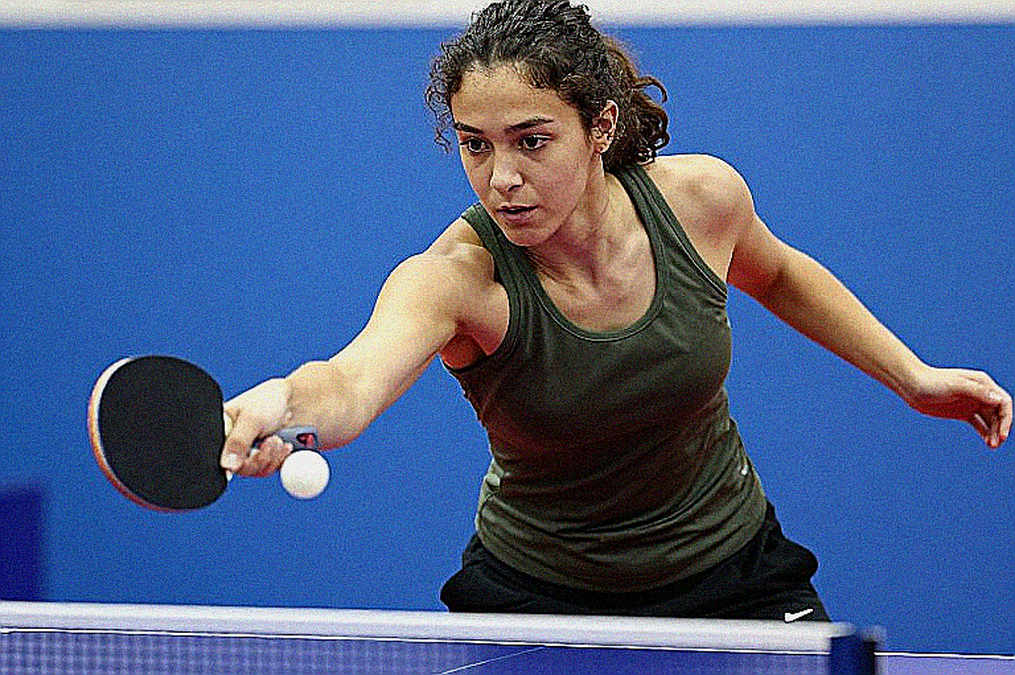
The U21 women's final in Pepinster ended on an 11-4 third game. Matilde Pinto of Portugal beat Hannah Silcock of England 3-0 — 11-8, 11-9, 11-4. A clean scoreline, an international title at exactly her age level.
Then, at the same tournament, she walked into the senior women's singles semifinal and lost 1-3 to Anais Salpin of France.
I have read that scoreline several times. Not to hunt for technical faults — the original bulletin from the European Table Tennis Union contains not one line of technical description, no playing style, no rubber, nothing about ball feel. I read it again because the distance between those two matches is exactly what I have chased for years: the moment a female athlete touches the ceiling of her age bracket, then is pushed onto the adults' court and realises she is not yet enough.
People ask me why, at 60, I still shout at the screen whenever I watch a women's table tennis match. I ask back: why should I stop? Matches like that senior semifinal in Pepinster have no loud crowd, no big cameras. If I do not shout, nobody shouts in my place.
Belgium Open 2026 took place in Pepinster, a small municipality in Belgium. This is a European regional open whose results were published by the ETTU, with two streams running side by side: U21 and senior singles. Let me say this plainly from the start: this is not the elite stage. It sits at the Feeder tier of the WTT system, or below — and the original bulletin does not confirm which. No Chinese, Japanese, Korean or other leading Asian players entered. The entry list runs across Europe: Portugal, Belgium, Denmark, Switzerland, England, Lithuania, Ukraine, Belarus, France, Czechia, Germany.
The year 2026 is the second year of the Los Angeles 2028 Olympic cycle. This is the audition phase. European associations are pushing the 2026-2026 cohort onto the international circuit to accumulate matches, before the real selection phase begins. An event like Pepinster exists to do exactly that — not to manufacture stars, but to show young players where they stand.
In that context, Portugal won both U21 singles titles: Clement Laine in the boys' draw, Matilde Pinto in the girls'. The bulletin calls it Portugal's double. As a statement of fact, that is correct.
The analysis lies in the score structure, not in the trophy.
Laine beat Gevers of Belgium 3-1 in the U21 boys' final: 11-6, 7-11, 11-4, 11-9. The game margins were win by 5, lose by 4, win by 7, win by 2. He lost game two, then won the next two by wide margins, including a seven-point third game. Earlier, in the semifinal, he beat Havsteen of Denmark 3-0. No technical data allows me to say Laine was stronger in any particular department. The only readable signal is his capacity to reset within a match: lose a game, then take the next by a wide margin. That is a weak signal. Positive, but weak. What we say about a player after an event like this should not exceed what the scoreboard permits.
Gevers reaching the U21 boys' final on home soil is a small but real signal about the host nation's pipeline. A home finalist at a home open is a familiar pattern, but it still shows at least one Belgian male U21 player operating near the top of a pan-European U21 field.
Pinto is the case worth dwelling on longer.
Her final scoreline looks like an easy win: 3-0. Read game by game, it was not easy at all. The first game 11-8, the second 11-9 — margins of just three and two points. Only the third game opened up, to 11-4, and that game broke only after Silcock lost the second in a close exchange. A 3-0 final decided by two points. Had Silcock taken game two, the story would read differently.
Earlier, in the semifinal, Pinto needed five games to beat Juchnaite of Lithuania, 3-2. That is the only match in the entire bulletin to reach a deciding game. So Pinto's record in this event has two faces: at the top end she wins in straight games; at the risk end she lets opponents drag her into a fifth, and an opponent with enough nerve in the first two games could have turned the final around.
Then came the senior semifinal. Pinto lost 1-3 to Salpin.
This is the single most analytically valuable line in the whole bulletin, and it sits at the end of the piece, almost buried. A player who has just won her age bracket then loses at the senior semifinal stage at the same event, hours or days later. That is the textbook signature of the age-category ceiling. She is good enough to win U21, but not yet good enough to close at senior level.
We need the wider senior picture to place Pinto properly. In the senior men's semifinals, Sip beat Vogler of Switzerland 3-0, and Ullmann beat Shutov 3-0. Both men's semifinals ended in straight games. When both semifinals are lopsided, I tend to suspect the final will be tighter than the semifinal scores suggest. In the senior women's semifinals, Baravok beat Vasylenko of Ukraine 3-0, and Salpin beat Pinto 3-1. The four senior finalists come from Germany, Czechia, France and Belarus — four European table tennis nations at different tiers. None of them is a global elite power, and that too says something about the level of the event.
I want to state one thing clearly that the bulletin does not: we do not know how long after the U21 final the senior semifinal took place. But at regional-tier events, draws are usually run in a compressed one- or two-day format, with multiple matches per player per day. Anyone entered in both the U21 and senior draws almost certainly carried a heavier match load than someone entered in one. I will not assign a cause to match load — the data does not permit it. But I cannot pretend it does not exist.
Here I want to push back on the bulletin's most attractive framing: Portugal's double.
A U21 title at a Feeder-tier event carries little or no senior world-ranking weight. It has developmental value, not commercial value. The bulletin names no equipment brand, no prize money, no sponsor, no broadcaster, no representation contract. For Laine and Pinto, any future commercial value depends entirely on whether they convert at WTT Contender level or above. A U21 title at a regional open, by itself, carries almost no weight in the current table tennis economy.
This is where I am always uneasy about how media handles the youth tier. The words European champion placed before U21 sound loud. They easily generate prodigy-style expectations. And when those expectations are not met, people turn around and blame the athlete — never the headline that inflated them in the first place. Two hundred and twelve views at 51 taught me more than 30 years in the studio: the things nobody bothers to measure are usually where the truth sits. A U21 scoreline in Pepinster is something nobody measures. It tells me more about the future of European women's table tennis than any star bulletin.
Women's table tennis does not need to be rescued. It needs to be seen with eyes that know how to see. A 20-year-old woman winning U21 then losing a senior semifinal at the same event is not a failure story. It is data about the gap between two tiers. And that gap is the thing worth writing about.
One further detail deserves recording, even though it sits outside the competition itself. The bulletin attributes Belarusian athletes by nationality: Katsiaryna Baravok and Nikon Shutov. Under the post-2026 ITTF framework, Belarusian and Russian athletes have often competed under neutral status without national attribution at many ITTF-sanctioned events. The bulletin's national attribution may be editorial shorthand rather than a statement of official status. That is a verification flag before citation, not an accusation. But for someone in my profession, a name given the wrong status matters as much as a name pronounced wrong. Every time I misname an athlete, I am not merely fixing an error — I am fixing the way the world looks at women in sport.
The U21-to-senior gap is the decisive variable for every player in this bulletin, and it needs 12 to 24 months to reveal itself. Based on my experience tracking matches at the youth tier, watch the next senior entries of Pinto and Laine, and watch whether Portugal produces anyone beyond these two names into U21 quarterfinals. If it is two people, that is an individual result. If it is a group, that is programme output. And programmes are what shift the landscape.
The final question is not whether Pinto won U21 — she did. The question is: when she next steps onto the adults' court, will anyone sit down long enough to read her scoreline the way it deserves to be read?
Cầu thủ liên quan
Bài đề xuất
LAINE and PINTO give Portugal both U21 titles at Belgium Open 20262026-09-21
Worthing TTC Launches Junior Team 1 Star: The Gap at the Base of England's Table Tennis Pyramid2026-09-18
Pinto Wins the U21 Title Then Loses the Senior Semifinal at the Same Event: The Gap at Pepinster2026-09-21
The 16-20 Gap: The Silent Drop-Off in Vietnamese Youth Table Tennis2026-09-16
Table Tennis England announces record 18-place DiSE intake for the 2026-28 cycle2026-09-16
Trophy Night on the Isle of Wight: Where Table Tennis Survives on Names Nobody Looks Up2026-09-18
From Binh Duong to MyUSATT: An App Cannot Return a Serve, But It Is Redrawing a Federation's Map2026-09-19
Bài đề xuất
Nine Layers of Table Tennis Data and the Cost of an Empty Analysis Sheet2026-09-16
Americas U11-U13 Championships: USA Claims 43 of 56 Medals in Katy, Texas2026-09-20
Pinto and Laine: Two U21 Titles and the Senior Transition Gap2026-09-21
The 16-20 Gap: The Silent Drop-Off in Vietnamese Youth Table Tennis2026-09-16
LAINE and PINTO give Portugal both U21 titles at Belgium Open 20262026-09-21
The Table Tennis Data Void: What an Analyst Writes When There Is Nothing to Verify2026-09-17
Portugal's U21 Double at Belgium Open 2026: Trophies Don't Lie, But They Don't Tell the Whole Truth2026-09-20