
BadmintonLakshya Sen at the 2026 Asian Games: Bracket, Head-to-Head and the Gap Between Expectation and Data
Lakshya Sen at the 2026 Asian Games: Bracket, Head-to-Head and the Gap Between Expectation and Data
Trả lời nhanh: Lakshya Sen được dự phóng vào thẳng vòng 32 đơn nam Asian Games 2026 nhờ suất bye, nhưng bảng đối đầu cho thấy anh thua về tổng thành tích hoặc vừa thua ở lần gặp gần nhất trước bốn trong năm đối thủ tiềm năng. Cơ hội huy chương vàng thấp hơn khung “đường tới vàng” mà truyền thông Ấn Độ dựng lên. Dữ kiện chính: - Loh Kean Yew (hạng 13) thắng Lakshya Sen tại Asia Team Championships tháng 2 năm 2026, dù Sen dẫn đối đầu tổng thể 7-4. - Jonatan Christie (hạng 1) dẫn Sen 4-3; Kunlavut Vitidsarn (hạng 3) dẫn 8-5; Shi Yuqi (hạng 6) dẫn 5-2. - Panitchaphon Teeratsakul (hạng 17) hòa 1-1 với Sen và thắng tại tứ kết Indonesia Masters bằng hai game thẳng. - Sen thắng Shi Yuqi ở vòng 1 All England 2026, giải Super 1000, chứng minh khoảng cách đối đầu có thể bị bẻ gãy. - Ấn Độ giành huy chương đồng đồng đội Asian Games 2026 sau khi thua Trung Quốc ở bán kết, trước khi bước vào nội dung cá nhân. Nguồn: Khel Now, bài dự phóng nhánh đấu đơn nam Asian Games 2026, dạng bình luận trước giải. Các số liệu xếp hạng và đối đầu trong nguồn chưa được xác minh độc lập. Hỏi đáp liên quan: Hỏi: Lakshya Sen gặp ai ở vòng 32 Asian Games 2026? Đáp: Theo nhánh dự phóng, anh gặp Loh Kean Yew, tay vợt Singapore hạng 13. Hỏi: Lakshya Sen có lợi thế gì tại Asian Games 2026? Đáp: Suất bye vào thẳng vòng 32 và thành tích đối đầu 7-4 trước Loh Kean Yew. Hỏi: Chiều sâu đơn nam châu Á đang thay đổi thế nào? Đáp: Thái Lan có hai suất trong nhóm dẫn đầu với Vitidsarn hạng 3 và Teeratsakul hạng 17, tín hiệu xây chiều sâu ngoài sở trường đôi.
In February 2026, at the Asia Team Championships, Loh Kean Yew beat Lakshya Sen. That was the most recent meeting between the two players. Open the overall head-to-head record and Sen leads 7-4. Two lines of data sit on the same page and tell two opposite stories. When a player leads a career series but lost the latest meeting, I mark that row red in my spreadsheet. It does not say who will win. It says the old model needs updating.
The 2026 junior match taught me to listen to small numbers. A whole team fits inside a spreadsheet. Since then, every time a player is pushed onto the top step by a story, I go looking for the data lines standing behind that story and check whether they agree to stand in the same place.
At the 2026 Asian Games in Aichi-Nagoya, Indian media are drawing a bracket that leads Lakshya Sen to the men's singles gold medal. I read the bracket, then the head-to-head record, then the order of the rounds. The three do not quite line up.
A FILTERED FIELD AND THE STRUCTURE OF THE EVENT
The Asian Games is a multi-sport event run by the Olympic Council of Asia, not part of the BWF World Tour. That means the field is filtered: Viktor Axelsen, Anders Antonsen and the entire European group are absent. What the source article calls “world No. 1” is really No. 1 within a set made up only of Asian federations. The ranking is still correct, but the sample has been cut, and every conclusion drawn from a cut sample needs a footnote.
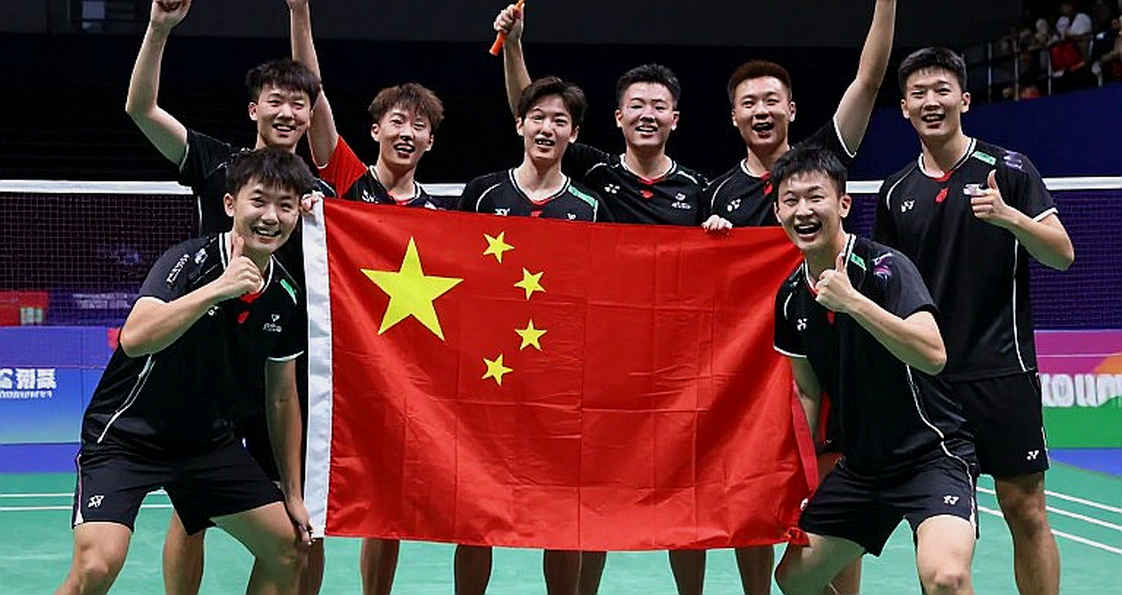
The team event is played before the individual event. India reached the team semifinal, lost to China and took bronze. Sen enters the individual knockout after having already spent part of his physical budget. For anyone working with load data, this is a point to circle: a multi-sport schedule is almost always an addition problem, rarely a subtraction problem.
The team semifinal against China deserves a closer look than a single line of result. In team events, a leading singles player often has to play twice on the same day — a doubles rubber and a singles rubber — and total court time in the team event can amount to a full knockout round. If Sen was used in both decisive ties, he enters the individual event with a recorded physical debt.
The men's singles format is pure single elimination. Sen has a bye and enters directly at the round of 32, meaning one fewer match than unseeded entrants. One fewer match in a tournament lasting five or six days sounds small, but it sits at the start of the draw, where the physical budget is still full and the cost of preserving it is low. I always rate a bye higher than the crowd does, because in knockout play most of the risk is front-loaded into the early rounds.
The rankings cited by the source article: Jonatan Christie No. 1, Kunlavut Vitidsarn No. 3, Shi Yuqi No. 6, Loh Kean Yew No. 13, Panitchaphon Teeratsakul No. 17. Sen's own ranking is never stated. That is the first gap, and it is not small. For the projected bracket to work — Loh in the round of 32, Christie in the quarterfinal, Shi in the semifinal, Vitidsarn in the final — Sen would have to be a top-eight seed; otherwise the seeding logic does not hold. I inferred that from the tournament structure, not from the source data.
ROUND OF 32: THE TEMPO TEST
Loh Kean Yew is the opponent the head-to-head record says Sen should beat, while recent form says the two are level. Loh plays with speed, attacks early and likes to push the tempo up from the first few rallies. For a player walking into the tournament off a bye, that kind of opponent is the most awkward test available: you have not found your rhythm before you are forced to play at someone else's speed.
On the night of the All England 2026 first round, I sat in front of a screen in Nha Trang at two in the morning and counted by hand how many times Sen changed the direction of the shuttle in the second game. I recorded 19 changes across 11 rallies. Nobody publishes that number; it appears in no official statistics table. But it showed me that Sen wins by bending the direction of play rather than by hitting harder. Against Loh, what he needs is not power but the ability to hold his own movement line through the first 15 minutes of the opening game.
The 7-4 career record stands with Sen. The most recent meeting stands with Loh. When two data lines collide, I always put the newer line on top, but I never delete the older one — deleting old data is the fastest way to fool yourself. This match sits in the grey zone, and the grey zone is where I am least willing to place a bet.
QUARTERFINAL: CHRISTIE AND THE RHYTHM PROBLEM
Jonatan Christie leads 4-3. This is the most evenly balanced match in the projected bracket, and also the one where the gap in playing style is wider than the gap in ranking. Christie plays a deceptive net game, controls rhythm and drags opponents into long rallies before changing direction suddenly on the third or fourth beat. He does not need to hit faster than his opponent. He needs his opponent to hit off-beat.
For an attacking player, that is the most irritating kind of opponent. I once counted how many times Christie forced opponents to play one extra shot in matches at the Indonesia Masters, and the average landed around seven to nine times per game. That metric also lives outside the official statistics tables, so I have to count by hand, exactly the way I once counted all 312 PVF passes when I was 17. Christie wins by stretching a match beyond his opponent's endurance, and Sen is precisely the kind of player he would rather meet in a quarterfinal than a semifinal.
One line the source article does quote — that Sen must disrupt Christie's rhythm and maintain his intensity — sounds reasonable, but it is true against every opponent alive. An instruction without data attached is just a good sentence.
SEMIFINAL: SHI YUQI AND EVIDENCE AGAINST THE TREND
Shi Yuqi leads 5-2, the widest margin in the projected bracket after Vitidsarn. But another piece of data sits right beside it: in the first round of the All England 2026, Sen beat Shi. A win at a Super 1000 event against this exact opponent is evidence that a head-to-head gap can be broken on a specific day.
I am not using it to say Sen will win the semifinal. I am using it to say the model is not allowed to assign zero probability to an outcome that has already happened. At the 2026 World Cup I bet on a homemade xG model. It was wrong, but it was mine. The lesson from that was not to abandon models; it was to separate “result” from “chance quality”, and “one match” from “one run of matches”.
The nature of the head-to-head metric needs stating clearly here. An H2H record is an accumulated figure; it compounds across years, physical phases and coaching changes. When a player enters his peak at 24 or 25, most of his head-to-head data was written during an earlier phase. Christie leads 4-3, Shi leads 5-2, Vitidsarn leads 8-5 — all of them include matches played when Sen was 19 or 20. That is why I always split H2H into two windows: the last three years, and everything else. The source article does not do this, and so it accidentally makes Sen look weaker than he is in some rows and stronger than he is in others.
FINAL: VITIDSARN AND THE PATIENCE PROBLEM
Kunlavut Vitidsarn leads 8-5, and the matches between them are described as closely contested battles. This is the most stylistically loaded match in the whole bracket. Sen attacks, comes to the net, looks for early winners. Vitidsarn defends, counterattacks, extends rallies and returns the shuttle opponents thought was a winner. In that matchup profile, history favours the more error-resistant player — and that is exactly the attribute the source article never analyses.
If Sen reaches the final, he will have to win a match through patience rather than power. For a player with attacking instincts, that is the hardest demand the format can make. The head-to-head data does not say Sen cannot do it. It says he has not done it often.
TEERATSAKUL, THE VARIABLE OUTSIDE THE PROJECTED PATH
Panitchaphon Teeratsakul, ranked No. 17, is tied 1-1 with Sen and beat him in straight games in the Indonesia Masters quarterfinal. If the actual draw puts him in Sen's path in the round of 16 or the quarterfinal, the entire calculation changes. This is the opponent Sen's current data set has not solved: same region, same attacking template, but reaching the shuttle earlier.
Thailand having two entries in the leading group — Vitidsarn at No. 3 and Teeratsakul at No. 17 — is the most notable structural signal in Asian men's singles. Thailand has long been known for doubles. The arrival of a second singles player inside the top 20 shows a country building depth rather than a single star.
PHYSICAL BUDGET AND THE UNWRITTEN COST
Five knockout matches across five or six days, each against a top-20 opponent, after already playing the team event. If Sen is pushed to a third game in the round of 32 and the round of 16, the physical budget left for the semifinal and final will be noticeably thinner. This is the kind of risk viewers skip over because it never shows on the scoreboard. People look at opponent names; few look at total minutes on court.
In 2026, empty stadiums, applause turned into noise. The number only appeared in the silence. What I learned in that period is that variables outside the official tables can still decide results: crowd noise, interval length, arena temperature. The cumulative load of a multi-sport schedule belongs to that same group.
THE MISSING METRICS
The source article provides no smash speed, no unforced-error rate, no average rally length, no deciding-game win rate, no match durations and no current ranking for Sen. For someone working as a data consultant, that is the list of things that must exist before anything at all is said about title chances. Without them, every conclusion is provisional — including the conclusions in this piece.
The source article also never mentions the coaching staff, the medical team or a recovery plan. For a projection about a path to a gold medal, that is a weighty omission, because the biggest question in any multi-event schedule is always the same: who manages the load, and how. I have no data to evaluate Sen's support team. I only record that the data does not exist in this source.
THE CONTRARIAN READ
The “path to gold” frame serves a very specific storytelling need: the media of a country that wants a hero in men's singles badminton. I understand the need. But the head-to-head record the source article itself cites says something else. Of the five projected opponents, Sen trails three on the overall record, has just lost to a fourth, and holds a clear edge over only one — who also beat him in the most recent meeting. That is the file of a dark horse, not the file of a favourite.
There is another trap in how the data gets read. Sen beating Shi at the All England 2026 does not prove he will beat Shi in an Asian Games semifinal. The two matches differ in conditions, in physical budget, in national pressure, in court surface and shuttle speed. Correlation between two results is not causation. That is a mistake I have made before and still have to remind myself about every week.
One further point the source leaves completely blank: whether the Asian Games awards BWF world ranking points. If it does not, the value of the event lies in national legacy, and competitive motivation will follow a different path from the World Tour. I am leaving that line marked pending verification. Data is impartial, but the person collecting it always brings his heart into the spreadsheet, and I know I lean toward the tragic scenario.
One structural detail deserves adding: India is the only country in the leading group of Asian men's singles with no player inside the top six. Indonesia has Christie, Thailand has Vitidsarn, China has Shi, Singapore has Loh. That gap is not Sen's problem alone; it is the problem of an entire development system. When a whole badminton nation pours its hopes into one person, the pressure transfers entirely onto that person's shoulders, and the data on how that kind of pressure affects performance in deciding games is fairly clear.
SIGNALS TO TRACK
My model does not say Sen will win the title or exit early. It only whispers: look in this direction.
Four signals will decide how this analysis gets re-read. The official draw is the first: if the order of opponents differs from the projection, the difficulty changes immediately. Alongside it is the duration of Sen's early matches — two three-game matches in the round of 32 and the round of 16 would be a bad sign for the semifinal. Movement quality on court after the team event belongs on the list too: if his footwork drops a beat in the second game of early matches, that is a physical signal, not a tactical one. And the ranking-point status of the event will determine where competitive motivation is placed.
For Lakshya Sen in Aichi-Nagoya, the bracket is opening a road that the head-to-head data does not support. If he walks the whole of it, the outcome is no longer a good week. It is a signal of structural shift in Asian men's singles. And if he exits early, the question left behind will not be what he lacks, but what Indian badminton prepared for him beyond expectation.

Cầu thủ liên quan
Bài đề xuất
Asian Games 2026: Satwik-Chirag Lose to World No. 36 and the Data Gap Around a Score Curve2026-09-25
India 3-0 Bangladesh at Asian Games 2026: The Quarter-Final Is Here, the Real Face Is Not2026-09-22
India's road to Asian Games 2026 badminton gold: A contradicted map and the two-pillar problem2026-09-20
India Open Women's Badminton at Asian Games 2026 Against Kazakhstan: The Warm-Up Beat of a Multi-Sport Games2026-09-20
The Nine-Dimension Blank Page: When a Badminton Analysis Chooses Silence2026-09-17
Olympic Cycle 2028: Vietnamese Badminton Lacks Data More Than Ranking Points2026-09-18
Badminton Injuries in Vietnam: The Competition-Load Problem and the Gap in Sports-Medicine Data2026-09-16
Bài đề xuất
Lakshya Sen and the Five-Match Corridor: A Risk Map for the 2026 Asian Games2026-09-25
Asian Games 2026: Indian Badminton Between Byes and Fateful Early Clashes2026-09-25
Southeast Asian Women's Badminton: A Generation Raised in an Unlit Garage2026-09-17
China, Two Gold Medals, and the Injury Question Before the 2026 Asian Games2026-09-17
India 3-0 Kazakhstan: Three Singles Settled It, and Two Doubles Rackets Never Got Called2026-09-21
Aarhus 2026: When the Stands Fell Silent, Badminton Data Changed Its Voice2026-09-17
Nagoya's tale of two teams: India men sweep Japan 3-0 to secure Asian Games medal; India women fall to singles collapse2026-09-23